Certified Fitness Trainer Course in India: Eligibility, Skills, Career Scope & How to Choose the Right Course
Learn about certified fitness trainer courses in India, including eligibility, curriculum, practical skills, career scope and how to choose the right programme.
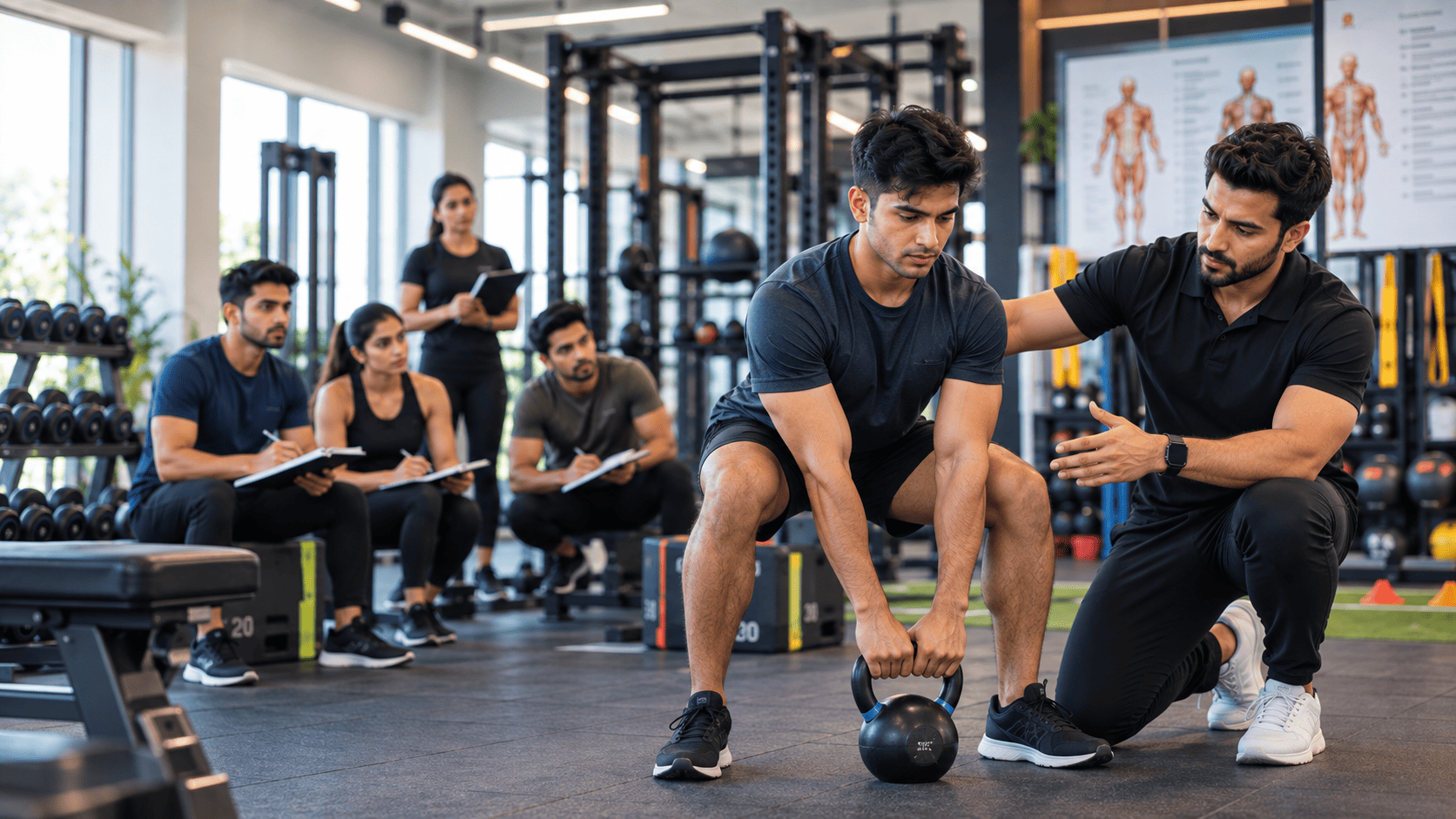
A certified fitness trainer course in India can provide a structured starting point for people who want to turn an interest in exercise into professional fitness work.
Learning to train people professionally involves much more than knowing how to perform exercises yourself. A trainer needs to understand human movement, exercise principles, client assessment, programme design, safety, communication and professional conduct.
The title “Certified Fitness Trainer” is used by different education providers, and the content, eligibility, assessment, practical exposure and recognition can vary substantially. That makes course selection important.
A certificate title alone does not tell you how deeply a programme teaches exercise science or whether the learning experience matches your intended career.
This guide explains what to look for in a certified fitness trainer course in India, including eligibility, curriculum, practical skills, career applications, online versus offline learning, certification and recognition, and a detailed framework for comparing courses before enrolling.
Table of Contents
- What Is a Certified Fitness Trainer Course?
- What Does a Fitness Trainer Actually Do?
- Who Can Become a Certified Fitness Trainer in India?
- Is Class 12 Enough to Start a Fitness Trainer Course?
- What Does a Certified Fitness Trainer Course Teach?
- Human Anatomy and Physiology
- Exercise Science and Training Principles
- Movement, Technique and Exercise Selection
- Fitness Assessment and Goal Setting
- Workout Programme Design
- Strength, Cardio, Mobility and Flexibility
- Basic Nutrition and Lifestyle Awareness
- Injury Prevention, Safety and Professional Boundaries
- Communication and Client Management
- Practical Training: Why It Matters
- Skills Every Certified Fitness Trainer Should Develop
- Certified Fitness Trainer vs Personal Trainer
- Career Scope After a Fitness Trainer Certification
- Where Can a Certified Fitness Trainer Work?
- Online vs Offline vs Hybrid Fitness Trainer Courses
- How to Choose a Certified Fitness Trainer Course in India
- Fitness Trainer Course Selection Scorecard
- How to Verify Certification and Recognition Claims
- Questions to Ask Before Enrolling
- Common Mistakes When Choosing a Fitness Trainer Course
- How CNES Fits Into the Fitness Trainer Education Pathway
- Frequently Asked Questions
- Final Thoughts
What Is a Certified Fitness Trainer Course?
A certified fitness trainer course is a structured education programme intended to develop the knowledge and practical skills needed to guide people through fitness training.
Depending on the provider, the programme may cover anatomy, physiology, exercise science, fitness assessment, programme design, resistance training, cardiovascular exercise, mobility, safety, communication and basic nutrition.
The exact meaning of the certification depends on who provides it, how learners are assessed and what the credential represents. Therefore, prospective students should look beyond the course title and review the actual syllabus, practical training, assessment and certification pathway.
A good course should help a learner understand not only what exercise to perform, but also why it is appropriate, how to modify it, how to monitor a client and when a situation falls outside the trainer's competence.
What Does a Fitness Trainer Actually Do?
A fitness trainer's day-to-day responsibilities can vary by workplace and role. Common responsibilities may include:
- Conducting basic fitness assessments within the scope of training.
- Understanding a client's goals, training history and relevant limitations.
- Planning exercise sessions and progressive training programmes.
- Demonstrating exercises and correcting technique.
- Selecting appropriate exercise intensity and volume.
- Monitoring training performance and progress.
- Adapting exercises for different fitness levels.
- Motivating clients and communicating clearly.
- Maintaining appropriate client records.
- Following gym, facility and professional safety procedures.
- Recognising situations that require referral to an appropriately qualified professional.
Professional fitness training is therefore a combination of technical knowledge, practical coaching and people skills.
Who Can Become a Certified Fitness Trainer in India?
There is no single universal eligibility rule for every fitness trainer course in India. Providers establish their own entry requirements.
Current Indian programmes demonstrate that requirements can differ. Some programmes list 10+2 or equivalent, while others may list 10th grade as their eligibility requirement.
Students should verify the exact eligibility criteria of the programme they want to join rather than assuming that every certification has the same academic requirement.
| Learner Background | What to Verify |
|---|---|
| After Class 10 | Whether the specific programme accepts 10th-pass learners. |
| After Class 12 | Whether the programme accepts 10+2 candidates and whether any additional requirements apply. |
| Graduate | Whether prior education changes eligibility or allows entry into advanced programmes. |
| Fitness Enthusiast | Whether previous gym experience is required or simply helpful. |
| Existing Trainer | Whether the programme is suitable for upskilling or whether an advanced certification is more appropriate. |
| Career Changer | Whether beginners are accepted and whether practical training is provided. |
Is Class 12 Enough to Start a Fitness Trainer Course?
For many entry-level programmes, completing Class 12 can be sufficient, but the exact rule depends on the provider.
More important than the minimum academic qualification is whether the course gives the learner enough structured education and practical experience to develop professional competence.
Students should also distinguish between eligibility to enrol in a course and eligibility for a specific job, advanced certification or professional registration. These are not necessarily the same thing.
What Does a Certified Fitness Trainer Course Teach?
A strong foundational programme should build knowledge progressively. Course content varies, but common subject areas include the following.
Human Anatomy and Physiology
Understanding the skeletal, muscular, cardiovascular and respiratory systems helps trainers understand movement and exercise responses. Anatomy should be connected to practical exercise rather than taught only as memorisation.
Exercise Science and Training Principles
Learners should understand concepts such as progressive overload, adaptation, recovery, intensity, volume, frequency and exercise selection.
Movement, Technique and Exercise Selection
A trainer should know how to demonstrate exercises, observe technique and make sensible modifications for different ability levels.
Fitness Assessment and Goal Setting
Training should begin with an understanding of the client's goals and relevant baseline information. Assessment methods should remain within the trainer's education and scope.
Workout Programme Design
Students should learn how to structure sessions and progress programmes based on goals, training status and response to exercise.
Strength, Cardio, Mobility and Flexibility
A broad foundation should cover major fitness components and explain how different training methods can be selected and progressed.
Basic Nutrition and Lifestyle Awareness
Fitness trainers may need basic nutrition literacy to communicate responsibly with clients.
A general fitness certification should not automatically be treated as clinical nutrition education.
Injury Prevention, Safety and Professional Boundaries
Safety, equipment use, spotting, recovery and appropriate referral are important parts of professional practice.
Communication and Client Management
Technical knowledge must be combined with active listening, clear instruction, motivation, time management and professional conduct.
Practical Training: Why It Matters
Fitness training is an applied profession. A learner can understand an exercise in theory and still struggle to demonstrate it, observe a client's technique or adjust a session in real time.
Practical training can help bridge that gap.
When comparing programmes, ask:
- How many practical sessions are included?
- Are exercises demonstrated and practised under supervision?
- Do students practise client assessment?
- Do learners design and deliver sample sessions?
- Is practical performance assessed?
- Who provides feedback?
- Are practical facilities available?
- Are practical components compulsory or optional?
A current Indian Certified Fitness Trainer programme from Fitness Matters, for example, describes offline interactive classes, a dedicated gym for practical classes, weekly reviews and tests, while its online version describes live interactive classes and practical-learning videos.
This illustrates why delivery format should be examined at the feature level rather than judged by the word “online” or “offline” alone.
Skills Every Certified Fitness Trainer Should Develop
Exercise Demonstration
Perform and explain movements clearly while observing technique.
Client Assessment
Collect relevant information and conduct appropriate basic assessments within scope.
Programme Design
Build structured sessions and progressions around realistic goals.
Observation
Notice technique, fatigue, movement limitations and changes in performance.
Communication
Explain instructions in a way the client can understand and apply.
Motivation and Rapport
Build professional relationships without making unrealistic promises.
Safety Awareness
Understand equipment safety, spotting, recovery and emergency procedures.
Adaptability
Modify exercises for different fitness levels and circumstances.
Documentation
Track relevant training information and progress appropriately.
Professional Ethics
Maintain confidentiality, avoid unsupported claims and recognise professional boundaries.
Referral Awareness
Know when a client requires another qualified professional.
Certified Fitness Trainer vs Personal Trainer
The terms “fitness trainer” and “personal trainer” are sometimes used interchangeably in the market, but course titles and programme scope can differ.
The safest approach is to compare the actual responsibilities and curriculum rather than assuming that one title always represents the same qualification everywhere.
| Area | Certified Fitness Trainer | Personal Trainer |
|---|---|---|
| Typical Focus | Foundational fitness instruction, exercise knowledge and general training skills. | Individualised coaching, client assessment, programme design and personal training delivery. |
| Work Setting | Gyms, fitness centres, studios and other fitness environments depending on qualification and employer. | Gyms, studios, private training, online coaching and other settings depending on qualification and employer. |
| Assessment | Depends on provider. | Depends on provider. |
| Certification Scope | Defined by the awarding organisation and programme. | Defined by the awarding organisation and programme. |
| Best Comparison Method | Review actual curriculum and practical requirements. | Review actual curriculum and practical requirements. |
The distinction is not universal. Some programmes use Certified Fitness Trainer as a broad foundational qualification, while others include substantial personal-training content. Always inspect the syllabus.
Career Scope After a Fitness Trainer Certification
Career opportunities depend on the credential, competence, employer requirements, location, experience and additional qualifications.
A certification can support entry into fitness work, but it should not be presented as a guarantee of employment or income.
- Commercial gyms and fitness centres.
- Personal training environments where the qualification meets employer requirements.
- Fitness studios and wellness facilities.
- Corporate wellness settings, where appropriate.
- Online fitness coaching, where the trainer has the required skills and business capability.
- Community fitness programmes.
- Sports and performance environments after obtaining appropriate additional education.
- Fitness entrepreneurship and independent coaching, subject to applicable business and professional requirements.
- Further education into personal training, strength and conditioning, nutrition or specialist populations.
The actual role available to a graduate depends on what the credential covers and what the employer or client requires. A foundational fitness trainer certificate should not automatically be presented as equivalent to every advanced fitness qualification.
Where Can a Certified Fitness Trainer Work?
| Setting | Potential Responsibilities |
|---|---|
| Gym / Fitness Centre | Exercise instruction, member support, basic assessments and supervised training within role. |
| Personal Training Studio | Individualised coaching where the trainer's qualification and competence meet requirements. |
| Wellness Facility | General fitness and lifestyle support within the role. |
| Corporate Wellness | Fitness education or coaching programmes where the employer requires such services. |
| Online Coaching | Remote coaching and programme support, provided the trainer has appropriate competence and systems. |
| Independent Fitness Business | Client training, workshops or coaching services within professional and legal boundaries. |
Online vs Offline vs Hybrid Fitness Trainer Courses
| Format | Potential Advantages | Potential Limitations |
|---|---|---|
| Online | Flexible schedule, geographic access, convenient for working learners. | Practical coaching quality depends heavily on how live/practical learning is designed. |
| Offline | Direct supervision, practical facilities and face-to-face feedback. | Fixed schedule, travel and potentially higher total cost. |
| Hybrid | Combines flexible theory with live or practical components. | Requires careful checking of what is actually delivered in each format. |
The correct choice depends on the learner's circumstances. For a beginner, practical support may be particularly important. For an experienced trainer seeking additional theory or a credential, a flexible format may be sufficient.
How to Choose a Certified Fitness Trainer Course in India
Do not choose a course only because it has the words “certified,” “international,” “advanced” or “professional” in its title. Compare the educational substance.
Curriculum
Is there a detailed syllabus covering anatomy, exercise science, assessment, programming, safety and coaching?
Practical Learning
How much supervised hands-on training is included?
Assessment
How is competence evaluated? Written test, practical assessment, case study or a combination?
Faculty
Are educator qualifications and industry experience transparent?
Recognition
Who issues the certificate and what exactly is recognised?
Learning Format
Does the mode provide the practical and academic support you need?
Study Resources
Are textbooks, digital resources, videos and revision materials included?
Student Support
Can learners receive feedback and ask questions?
Career Relevance
Does the course match the type of fitness work you want to pursue?
Long-Term Development
Does the provider offer advanced programmes or continuing education?
Total Cost
What are the course, assessment, certificate, travel and future renewal costs?
Fitness Trainer Course Selection Scorecard
Score each course from 1 to 5. Use the same criteria for every provider so that the comparison is based on evidence rather than advertising.
| Factor | Score / 5 | What to Verify |
|---|---|---|
| Curriculum Depth | ___ | Does the syllabus cover the foundations required for the intended role? |
| Practical Training | ___ | How much supervised practice is included? |
| Assessment | ___ | Is practical competence evaluated? |
| Faculty | ___ | Are qualifications and relevant experience transparent? |
| Recognition | ___ | Can important recognition claims be verified? |
| Learning Format | ___ | Does the delivery method suit your needs? |
| Student Support | ___ | What feedback and academic support are available? |
| Career Relevance | ___ | Does the programme match the intended work setting? |
| Total Cost | ___ | What is the complete cost through certification? |
| Further Learning | ___ | Is there a pathway for advanced education? |
How to Verify Certification and Recognition Claims
Fitness education uses terms such as certified, accredited, affiliated, approved, recognised and internationally recognised. These terms should not be assumed to mean the same thing.
- Identify the exact organisation issuing the credential.
- Identify whether the claim applies to the course, provider, qualification or continuing education.
- Check the awarding or recognising organisation's current official information where possible.
- Confirm the exact course title and current status.
- Ask whether the credential requires an examination or assessment.
- Check whether professional registration is separate from course completion.
- Do not interpret a certificate as automatic employment eligibility in every gym, country or professional setting.
CNES currently states on its franchise page that its education network includes recognition or relationships involving EREPS, SPEFL-SC, ISSA, ACE, NASM/AFAA and FWPI, while its faculty page identifies several trainers with NSQF Level 4 Fitness Trainer credentials.
These are current CNES website claims; prospective students should verify the exact recognition attached to the specific programme they are considering.
Questions to Ask Before Enrolling
- What is the complete syllabus?
- How many total learning hours are included?
- How much practical training is compulsory?
- How is practical competence assessed?
- Who teaches the programme?
- What are the faculty qualifications?
- Who issues the certificate?
- What recognition or affiliation applies to the specific course?
- Is the examination included?
- Are study materials included?
- Are first aid or CPR requirements included or separate?
- What happens if I fail an assessment?
- Are there additional certificate or registration fees?
- What is the course duration and delivery mode?
- What student support is available?
- Does the provider offer advanced or continuing education?
- What types of jobs or work settings is the qualification designed to support?
Common Mistakes When Choosing a Fitness Trainer Course
Choosing Only by Price
A low fee does not automatically mean poor quality, and a high fee does not automatically mean better education.
Choosing Only by Certificate Name
Titles vary between providers. Compare curriculum and assessment.
Ignoring Practical Training
Fitness coaching is an applied skill. Theory alone may not provide enough practice.
Assuming Online Means Easier
Online learning can be rigorous or weak depending on assessment and support.
Believing Every Recognition Claim
Verify who recognises what.
Ignoring Scope of Practice
A fitness trainer should know where general coaching ends and specialist or healthcare support begins.
Overlooking Faculty
The quality of teaching and feedback can materially affect learning.
Assuming Employment Is Guaranteed
A certificate does not guarantee a job, salary or client base.
Skipping the Fine Print
Check exam, retake, certification, renewal and other additional fees.
Not Planning the Next Step
Consider whether you may later need personal training, strength and conditioning, nutrition or specialist education.
How CNES Fits Into the Fitness Trainer Education Pathway
CNES currently lists Certified Fitness Trainer among its professional certification programmes on its public franchise page, alongside Certified Personal Trainer, Strength & Conditioning Coach, Diploma in Nutrition & Fitness, Diploma in Special Population and Yoga Teacher.
The current CNES faculty directory also identifies multiple educators with fitness-training qualifications, including NSQF Level 4 Fitness Trainer credentials.
The faculty profile for Babul Saha, for example, lists NSQF Level 4 Fitness Trainer and Master Trainer credentials; other faculty profiles list Level 4 Fitness Trainer qualifications as well.
Because the current public CNES pages reviewed for this article do not provide a dedicated Certified Fitness Trainer course page with a complete fee, eligibility and syllabus specification, this article intentionally does not invent those details.
Prospective students should request the current course-specific information from CNES before enrolling.
When evaluating the CNES Certified Fitness Trainer pathway, use the same independent framework described in this guide: curriculum, practical training, assessment, faculty, recognition, learning format, student support, total cost and future education options.
CNES website: https://cnes.online
Frequently Asked Questions
What is a Certified Fitness Trainer course?
It is a structured fitness education programme designed to teach foundational exercise science, training, assessment, programme design, safety and coaching skills. Exact curriculum and credential scope depend on the provider.
Who can join a Certified Fitness Trainer course in India?
Eligibility varies. Current Indian programmes demonstrate different requirements, including 10th grade and 10+2 entry pathways. Check the exact provider requirements before enrolling.
Can I become a fitness trainer after Class 12?
Many entry-level programmes accept 10+2 candidates, although requirements vary by provider.
Do I need previous gym experience?
Not necessarily. Some programmes are designed for beginners. Previous gym experience can help, but it is not a substitute for structured education.
What should a Certified Fitness Trainer course teach?
A strong foundation may include anatomy, physiology, exercise science, movement and technique, fitness assessment, programme design, strength, cardio, mobility, safety, communication and professional boundaries.
Is practical training important?
Yes. Fitness training is an applied profession, so supervised practice and practical assessment can help learners develop coaching competence.
Can a Certified Fitness Trainer work in a gym?
Potentially, depending on the credential, employer requirements, competence and local circumstances.
Is Certified Fitness Trainer the same as Personal Trainer?
Not universally. Course titles and scopes vary. Compare the actual syllabus and intended role rather than relying on the title alone.
Can I work online after certification?
Online coaching may be possible depending on competence, business setup, applicable requirements and the type of service offered.
Does a fitness trainer certificate guarantee a job?
No. A certificate can support professional development, but employment and income depend on qualifications, skills, experience, market demand and employer requirements.
How do I choose the right fitness trainer course?
Compare curriculum, practical learning, assessment, faculty, recognition, delivery format, support, total cost and career relevance.
Does CNES offer a Certified Fitness Trainer programme?
CNES currently lists Certified Fitness Trainer among its professional certification programmes on its franchise page. The exact current course-specific syllabus, eligibility and fee should be verified directly with CNES before enrolment.
What qualifications do CNES faculty members have?
The current CNES faculty directory lists a range of qualifications, including NSQF Level 4 Fitness Trainer credentials among several faculty members, along with personal training, strength and conditioning, nutrition and other specialist qualifications.
Final Thoughts
A Certified Fitness Trainer course can be a useful starting point for someone who wants structured education before working professionally in fitness. But the certificate itself should not be the only consideration.
The strongest course-selection process begins with your intended career role. Then compare the curriculum, practical learning, assessment, faculty, recognition, learning format, student support and total cost.
A programme that looks attractive on paper may not be suitable if it provides little practical exposure or does not match the work you want to do.
For beginners, practical competence and strong fundamentals are particularly important. For experienced fitness professionals, the right programme may be one that fills specific knowledge gaps or provides a recognised progression pathway.
The goal is not simply to collect a certificate. The goal is to build the knowledge, practical ability, communication skills and professional judgement required to work responsibly with people.
Ready to Explore a Certified Fitness Trainer Pathway?
If you are considering a certified fitness trainer course in India, start by writing down the type of fitness work you want to pursue. Then compare two or three programmes using the scorecard in this guide.
If CNES is one of the programmes you are considering, request the current Certified Fitness Trainer syllabus, eligibility, learning format, assessment details, certification information and fee structure directly from CNES before enrolling.
The current CNES website confirms Certified Fitness Trainer as part of its professional programme portfolio, but course-specific details should be verified for the current intake.
Explore CNESOfficial CNES website: cnes.online
Fitness education is a trust-sensitive topic. Do not imply guaranteed employment, salary, client acquisition or international practice rights.
CNES-specific course details should be verified against current official course documentation before publication.
Recognition, affiliation and certification claims should be checked against the relevant current official source and should not be treated as interchangeable terms.
Related Articles
Personal Trainer Course Fees in India: Complete 2026 Cost & Comparison Guide
Compare personal trainer course fees in India, what different programmes include, why prices vary and the costs to consider before choosing a certification.
Why a Gym Franchise Alone Isn't Enough: How Fitness Education Can Build a Stronger Gym Business in India
Explore how fitness education, professional certifications and trainer development can complement a gym business and create additional opportunities beyond memberships.
Certified Nutrition Coach Course in India: Eligibility, Curriculum, Career Scope & How to Choose the Right Course
Compare certified nutrition coach courses in India by curriculum, eligibility, assessment, practical learning, recognition, career scope and professional boundaries before enrolling.