Diet & Nutrition Coach Course in India: Career Scope, Eligibility, Skills and How to Choose the Right Course
Thinking about a career in nutrition or wellness? Learn what to look for in a Diet & Nutrition Coach course in India, including eligibility, curriculum, practical skills, career applications, professional boundaries and how to compare courses before enrolling.
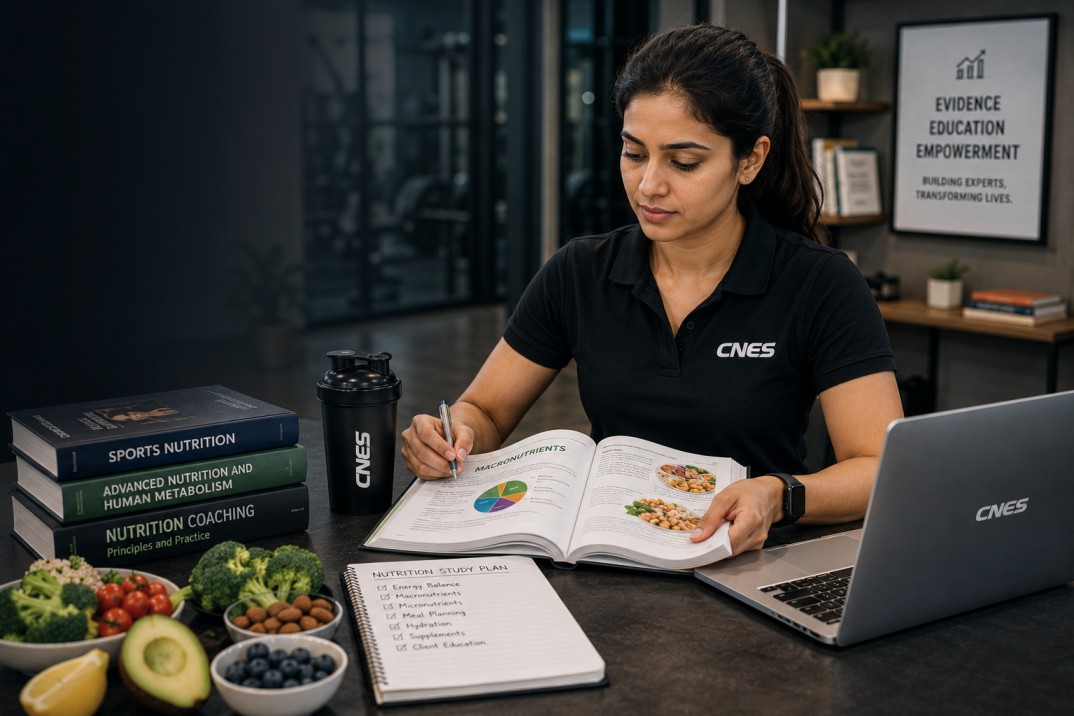
A Diet & Nutrition Coach course in India is designed to help learners build structured knowledge about general nutrition principles and, depending on the programme, develop skills relevant to communicating about healthy eating, supporting behaviour change and working within appropriate professional boundaries.
It may be relevant to students, fitness professionals, personal trainers, gym owners and working professionals who want to understand nutrition more deeply.
However, the title of a course is not enough to explain what a graduate is qualified to do.
General nutrition education, nutrition coaching, professional scope of practice and medical nutrition therapy are different concepts.
A nutrition certification does not automatically make someone qualified to diagnose disease, prescribe medical treatment or replace a registered dietitian, physician or other appropriately qualified healthcare professional.
This guide explains what to look for in a diet and nutrition coach course, who may be eligible, how career applications can differ and how to compare programmes carefully before enrolling.
What Is a Diet & Nutrition Coach Course and Who May Benefit?
A nutrition coach course typically focuses on education and coaching skills related to food, eating habits and general nutrition principles.
The exact depth varies widely between programmes. Some may focus primarily on introductory nutrition knowledge, while others may combine nutrition fundamentals with fitness, weight-management or behaviour-change concepts.
Potential learners may include:
- Students exploring a nutrition-related career direction
- Graduates seeking additional professional knowledge
- Personal trainers who want a stronger understanding of general nutrition education
- Gym owners and fitness professionals who communicate with clients about healthy lifestyle habits
- Working professionals considering a change of direction
The key is to match the course to your intended role.
If your goal involves clinical care, disease management or medical nutrition therapy, you should investigate the qualifications and regulatory or professional requirements relevant to that work rather than assuming a short coaching course provides the same preparation.
What Does a Nutrition Coach Typically Learn?
Course content varies, so students should always request the exact curriculum.
Depending on the programme, a nutrition and fitness course may cover areas such as:
Nutrition Fundamentals
Basic concepts used to understand food, nutrients and healthy eating patterns.
Macronutrients
The broad roles of carbohydrates, proteins and fats in the diet.
Micronutrients
General understanding of vitamins, minerals and their importance in nutrition.
Energy Balance
The relationship between energy intake, expenditure and body-weight change as a general educational concept.
Healthy Eating Principles
How broad dietary patterns and food choices can be discussed in a general educational context.
Weight-Management Fundamentals
General concepts around sustainable behaviour, energy balance and lifestyle habits, while avoiding unsupported promises or treatment claims.
Client Communication
How to explain concepts clearly, listen effectively and avoid overstating certainty.
Behaviour Change
Goal setting, habits, consistency, barriers and practical support strategies.
Nutrition Coaching Boundaries
Understanding what falls within the learner's training and when a question may require referral.
Referral to Qualified Professionals
Recognising situations involving disease, medical treatment or other complex needs that may be outside a coach's competence.
These are examples of topics that a nutrition coach may study. They are not claims that every course—or any specific CNES course—covers them in the same way.
General Nutrition Education, Nutrition Coaching and Medical Nutrition Therapy Are Not the Same
One of the most important decisions a learner can make is to understand the boundary between education and healthcare.
General nutrition education may involve explaining broad concepts.
Nutrition coaching may involve supporting general goals, habits and accountability within the coach's competence.
Medical nutrition therapy is a healthcare-related activity and should not be casually treated as interchangeable with general coaching.
The appropriate boundary depends on a person's training, credentials, applicable professional requirements and the nature of the client's needs.
When a client presents a disease, medical condition, treatment issue or complex clinical concern, a coach should not assume that a general certification gives them authority to diagnose or provide medical treatment.
Dietitian vs Nutritionist vs Nutrition Coach
These terms can be used differently across countries, organisations and professional contexts.
Training, title protection and regulatory requirements may vary. The table below is therefore a general comparison framework, not a universal legal definition for every jurisdiction.
| Role | Typical Focus | Training / Regulatory Considerations | Appropriate Client Boundaries |
|---|---|---|---|
| Dietitian | Food and nutrition practice that may include clinical or therapeutic nutrition depending on the person's qualifications and setting. | Education, professional standards and title requirements can vary by jurisdiction; check the relevant official body. | Should work within the qualifications, professional standards and applicable requirements governing the role. |
| Nutritionist | A broad title used differently across contexts. | The title may have different training and regulatory implications depending on location and organisation. | Scope should be based on verified qualifications, competence and applicable requirements. |
| Nutrition Coach | General nutrition education, habits, behaviour support and coaching within training and competence. | A course certificate alone does not automatically establish clinical authority. | Should not represent general coaching education as authority to diagnose disease or provide medical nutrition therapy. |
| Physician or Other Qualified Healthcare Professional | Medical assessment, diagnosis and treatment within the professional's authorised scope. | Requires the relevant regulated professional education and credentials. | Medical decisions should remain with appropriately qualified healthcare professionals. |
Who Can Pursue a Diet & Nutrition Coach Course?
Nutrition course eligibility varies by provider.
Depending on the programme, applicants may include students, graduates, fitness professionals, personal trainers, gym professionals or working adults.
Some courses may have minimum education, age or prerequisite requirements, while others may be designed for beginners.
Before enrolling, check the exact entry criteria rather than assuming that every nutrition certification course in India has the same requirements.
- Review minimum age and education requirements.
- Check whether prior fitness or nutrition knowledge is expected.
- Ask whether the course is designed for beginners or existing professionals.
- Confirm language, technology or attendance requirements.
- Understand whether any previous qualification is required for advanced modules.
Career Applications and Opportunities
A nutrition coach career can take different forms depending on a person's education, experience, other qualifications and professional boundaries.
Completing a course does not guarantee a job, salary level or permission to perform every nutrition-related role.
Depending on the exact training and competence developed, learners may work in or explore opportunities connected with:
General Wellness
General wellness and lifestyle education.
Fitness & Gym Environments
Nutrition-related education alongside fitness services where appropriate.
Personal Training Support
Nutrition discussions that remain within appropriate professional boundaries.
Wellness Coaching
Habit-support and general lifestyle coaching roles.
Health & Fitness Content
Content or education roles where claims remain evidence-based and within competence.
Corporate & Community Wellness
Wellness initiatives depending on the requirements of the organisation and role.
Further Education
Additional education in fitness, nutrition or related disciplines.
The responsibilities attached to any role should be checked individually.
Employers may have their own qualification requirements, and healthcare-related roles can involve additional professional standards.
What Skills Matter Beyond a Certificate?
Communication
A good coach must explain ideas clearly, listen carefully and avoid confusing confidence with expertise.
Evidence Evaluation
Nutrition information is full of trends and strong claims. Learners benefit from understanding how to question sources and distinguish evidence from marketing.
Behaviour-Change Support
People often need realistic strategies for consistency rather than another complicated list of rules.
Ethical Boundaries
Know what you are qualified to discuss and avoid making diagnostic, treatment or cure claims outside your competence.
Record Keeping
Professional organisation may involve keeping suitable notes while respecting privacy and applicable requirements.
Knowing When to Refer
Recognise when a client's needs may require a registered dietitian, physician or other qualified healthcare professional.
Continued Learning
Nutrition knowledge evolves, so responsible professionals should update their understanding rather than relying permanently on one course.
How to Choose a Diet & Nutrition Coach Course in India
The best choice depends on your goals, starting knowledge and intended professional direction.
Use a structured comparison rather than choosing only by price, duration or marketing claims.
Curriculum
Ask for a detailed module list and check whether the learning objectives match your goal.
Faculty
Look for transparent information about educators and relevant qualifications.
Scientific Approach
Check whether the course encourages evidence evaluation and avoids sensational or unsupported promises.
Practical Application
Understand how learners apply concepts through examples, cases, coaching practice or other suitable methods.
Assessment
Ask how learning is evaluated. Completion alone is not the same as demonstrating understanding.
Eligibility
Confirm that your education and background match the programme's requirements.
Learning Format
Compare online, offline and hybrid options according to your schedule and need for interaction.
Certificate Details
Know exactly what certificate is awarded and what it represents.
Scope-of-Practice Education
A trustworthy course should not encourage learners to act beyond their competence.
Student Support
Consider access to educators, feedback, learning resources and reasonable clarification support.
Nutrition Course Selection Scorecard
Score each course from 1 to 5, where 1 means poor or unclear and 5 means strong and independently verifiable.
The score is a decision aid, not a substitute for checking official information.
| Factor | Score 1–5 | Questions to Ask |
|---|---|---|
| Curriculum Quality | ___ / 5 | Is the syllabus detailed, relevant and appropriately structured? |
| Evidence-Based Approach | ___ / 5 | Does the course explain how claims and sources should be evaluated? |
| Practical Relevance | ___ / 5 | How will I apply concepts in realistic coaching situations? |
| Faculty | ___ / 5 | Are educator qualifications and experience transparently explained? |
| Assessment | ___ / 5 | How is understanding or competence actually evaluated? |
| Student Support | ___ / 5 | What access to feedback, clarification or learning support is available? |
| Recognition / Accreditation Verification | ___ / 5 | Can important claims be checked independently through official sources? |
| Career Relevance | ___ / 5 | Does the course match the type of work I realistically want to pursue? |
| Scope-of-Practice Education | ___ / 5 | Does the programme clearly teach boundaries and referral responsibilities? |
Important: Do not select a course only because it achieves a high total score. Look closely at any category scoring 1 or 2. A weak score in evidence, assessment or scope education may matter more than a high score for convenience or marketing appeal.
Online vs Offline Nutrition Education
Online Nutrition Course: Potential Advantages
- Flexible scheduling
- Ability to study from different locations
- Potentially easier access for working professionals
- Opportunity to revisit digital learning materials where provided
Online Nutrition Course: Potential Limitations
- Requires self-discipline and time management
- Interaction and immediate feedback may be more limited depending on the programme
- Practical or coaching skills may need additional structured opportunities
- Course quality varies substantially between providers
Offline Nutrition Education: Potential Advantages
- Direct interaction with educators and peers
- Potentially easier real-time discussion and feedback
- Structured learning environment
- Useful for programmes with significant in-person practical components
Offline Nutrition Education: Potential Limitations
- Fixed schedules and location requirements
- Travel and accommodation may add costs
- Less flexible for some working professionals
Hybrid Learning
A hybrid format can combine digital theory with live sessions or practical learning.
Whether this is the right choice depends on the actual course design, not the word “hybrid” itself.
How to Avoid Choosing a Poor-Quality Nutrition Course
This is where prospective learners can protect both their investment and their future professional credibility.
Be cautious when a provider:
Be cautious when a short course is presented as making you an expert in every nutrition-related situation.
Be cautious when a provider suggests graduates can diagnose diseases or replace medical professionals without clearly supported qualifications.
Be cautious when phrases such as “internationally recognised” are used without naming the organisation or verification method.
A prospective learner should be able to understand what they are paying to study before making a commitment.
Look for transparent information about educators and their relevant expertise.
Learning outcomes should matter more than celebrity endorsements, dramatic transformations or income promises.
Be cautious of outdated, absolute or sensational claims about foods, supplements or rapid weight loss.
Watching lessons or completing content is not automatically the same as demonstrating competence.
A responsible programme should explain professional boundaries and when referral may be appropriate.
Be cautious of pressure that prevents you from independently checking the course before paying.
A good decision process is slower than an advertisement. Ask for evidence, read the curriculum, verify important claims and compare several pathways.
How CNES's Relevant Nutrition Education May Fit the Needs of a Prospective Learner
CNES should be evaluated using the same standards applied throughout this guide.
A prospective learner should review the current official information for the relevant CNES Diet & Nutrition Coach course and, where relevant, the Diploma in Nutrition & Fitness programme.
Before publication, the website content team should verify the exact current curriculum, eligibility, learning format, assessment approach, faculty information and certificate details from official CNES course pages.
Only those verified details should be added as specific CNES claims.
For example, if an official course curriculum explicitly confirms particular modules, practical components or assessment methods, those facts can be described here.
If a detail is not supported by the official course information, it should not be inferred from the course title or from general nutrition education practice.
This evidence-based approach allows readers to determine whether the learning structure, level and stated outcomes match their own goals without implying that the programme authorises medical diagnosis, treatment or practice outside a learner's verified professional competence.
A Practical Path for Fitness Professionals
For an existing personal trainer, nutrition education may be useful as a complementary area of learning.
It can help improve general understanding of nutrition concepts, communication and behaviour support while reinforcing the importance of professional boundaries.
It should not be treated as a shortcut to practising medicine or providing clinical nutrition therapy. The exact value of additional nutrition education depends on the trainer's role, other qualifications and the services they intend to provide.
Where contextually appropriate, readers can also explore the CNES Certified Personal Trainer course as part of a broader fitness education pathway.
Frequently Asked Questions
Eligibility depends on the course. Students, graduates, fitness professionals and working adults may be able to pursue relevant programmes, but you should check the exact provider's entry requirements.
A medical degree is not automatically required to study general nutrition education or nutrition coaching.
However, a general coaching certificate should not be represented as medical training or authority to diagnose or treat disease.
The answer depends on the person's verified qualifications, professional scope and applicable requirements.
A general nutrition coaching certificate should not automatically be treated as authority to provide medical nutrition therapy or clinical treatment plans.
The terms can have different meanings depending on the jurisdiction and professional context.
A nutrition coach generally focuses on education, habits and behaviour support within competence, while “nutritionist” may carry different training or regulatory implications.
Verify the exact qualifications behind the title.
Yes, fitness professionals may pursue nutrition education if they meet a programme's eligibility requirements.
They should still work within their competence and understand when referral is appropriate.
Compare curriculum, faculty, evidence-based approach, practical application, assessment, eligibility, learning format, certificate details, scope-of-practice education and student support.
Use the scorecard in this article to structure your comparison.
Neither format is automatically better.
Compare the actual curriculum, assessment, interaction, practical relevance and the learning style that suits you.
No. A certificate does not guarantee employment.
Career development also depends on competence, communication, experience, professional boundaries, opportunities and employer or client expectations.
Final Thoughts
Choosing a diet and nutrition coach course in India is not simply about finding a certificate with the right title.
The quality of the curriculum, scientific approach, practical relevance, assessment and scope-of-practice education can have a major effect on what you actually learn.
Start by defining your goal.
If you want general nutrition knowledge and coaching skills, compare programmes on their educational quality and boundaries.
If your ambition involves clinical nutrition, disease management or medical treatment, investigate the separate professional education and requirements relevant to that work.
Before enrolling:
- Use the Nutrition Course Selection Scorecard.
- Verify important provider claims.
- Review the exact CNES course information if CNES is one of the education pathways you are considering.
Ready to Explore a Nutrition Education Pathway?
If you are considering a nutrition coach course in India, begin by identifying your career goal and understanding the difference between general nutrition education, nutrition coaching and clinical healthcare practice.
Compare curriculum, faculty, evidence-based learning, practical application, assessment, eligibility and scope-of-practice education before making your decision.
If CNES is one of the pathways you are considering, review the current CNES Diet & Nutrition Coach course information and compare it against the criteria outlined in this guide.
Publishing & Trust Note: CNES-specific curriculum claims should be verified against the current official course information before publication. Nutrition-related content is trust-sensitive, so avoid disease-treatment, supplement-prescribing, diagnostic or personalised medical advice claims.
Course eligibility, curriculum, learning formats, assessment structures and certificate details can change. Verify current programme information before enrolling.