Best Personal Trainer Course in India in 2026: How to Choose the Right Certification
Looking for the best personal trainer course in India? Learn how to compare certifications based on accreditation, curriculum, practical training, eligibility, faculty, assessment, recognition, fees and career support before you enrol.
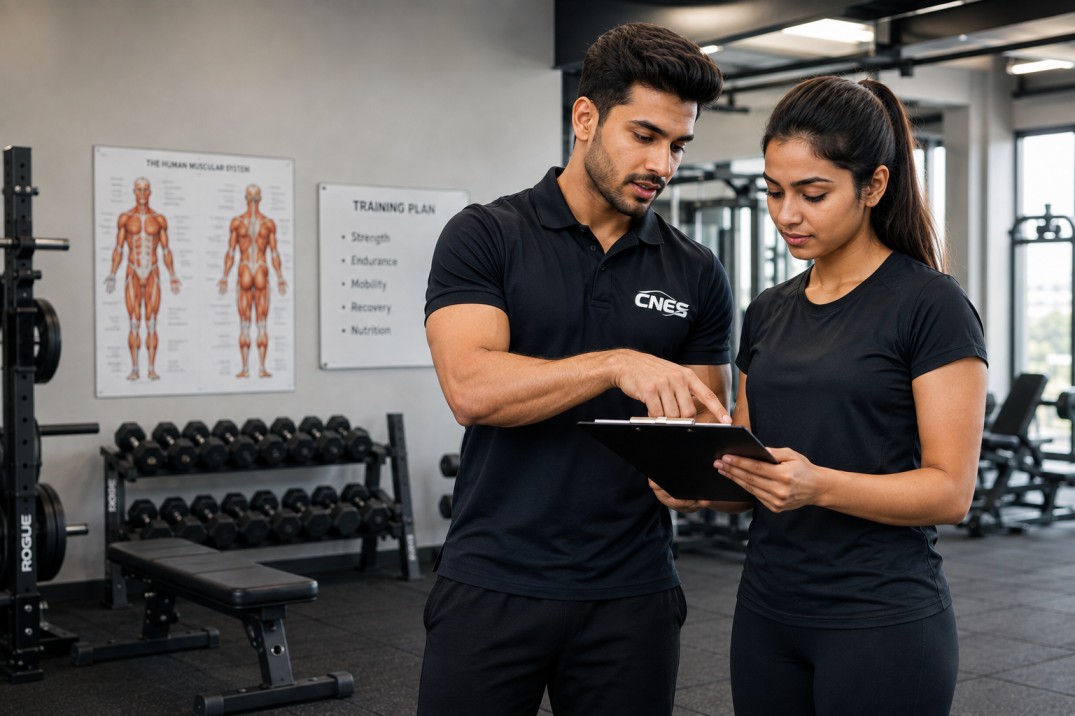
Choosing a personal trainer course is an important career decision. With a growing number of online, offline and hybrid fitness certifications available, it can be difficult to understand what actually makes one programme more suitable than another.
The best personal trainer course in India is not necessarily the one with the biggest advertisement, the lowest fee or the most impressive-looking certificate. The right course should match your career goals and provide relevant knowledge, practical competence, credible standards and a clear understanding of what you will be qualified to do after completing it.
Before enrolling, look closely at the curriculum, assessment process, practical training, faculty, recognition, eligibility requirements and the exact claims made by the course provider.
This guide will help you compare your options more carefully.
Quick Answer: Which Is the Best Personal Trainer Certification in India?
There is no single certification that is objectively the best for every aspiring fitness professional.
The right personal trainer certification in India depends on several factors, including:
- Your current education and experience
- Your career goals
- The knowledge and practical skills you need
- Whether you want to study online, offline or through a hybrid format
- The standards or accreditation associated with the programme
- How the course assesses practical competence
- The provider's faculty and educational approach
- Your budget and the overall value of the programme
- Whether the certification pathway is relevant to the market or career direction you are targeting
Instead of asking only, “Which certificate is the most famous?”, ask:
“Will this course give me the knowledge, practical competence and credible pathway I need for the type of personal trainer I want to become?”
That question leads to a much better decision.
Why Choosing the Right Personal Trainer Course Matters
Personal training involves more than demonstrating exercises. A competent personal trainer may need to understand how to assess a client's starting point, select and adapt exercises, design structured programmes, communicate effectively, monitor progress and work within appropriate professional boundaries.
That is why the quality of the learning process matters as much as the certificate itself.
A course may look attractive because it is quick or inexpensive, but before enrolling, consider what is actually included.
- How deeply does the course cover anatomy and physiology?
- Are exercise science concepts explained clearly?
- Do you learn how to conduct client assessments?
- Is programme design taught in a structured way?
- Is practical competence assessed?
- Who teaches the course?
- What recognition or standards can the provider independently verify?
- Are you being shown exactly what the qualification does—and does not—represent?
The best decision is usually based on evidence and fit, not marketing claims.
What Should You Look for in a Personal Trainer Course?
1. A Curriculum Built Around Relevant Knowledge and Skills
Ask for the actual curriculum before enrolling. A comprehensive certified personal trainer course may cover areas such as:
- Basic anatomy and physiology
- Exercise science
- Biomechanics and movement
- Health and fitness screening
- Client assessment
- Exercise selection
- Resistance training principles
- Cardiovascular exercise
- Flexibility and mobility
- Programme design
- Progression and regression
- Client communication
- Behaviour change and motivation
- Health and safety
- Professional ethics and boundaries
The exact depth and coverage will vary between programmes.
Questions to Ask
- Can I see the detailed syllabus?
- How much of the course focuses on theory versus application?
- Are assessments and programme design taught?
- Does the course explain how to adapt programmes for different individuals?
- Is practical competence included in the learning process?
A course title alone cannot answer these questions. Always examine the actual learning outcomes.
2. Exercise Science, Anatomy and Physiology
A personal trainer does not need to become a medical doctor to understand the human body—but professional exercise instruction requires more than memorising workouts from social media.
Before choosing a fitness trainer certification in India, check whether the programme provides an appropriate foundation in subjects such as anatomy, physiology and exercise principles.
You should be able to understand concepts such as:
- Major muscles and their functions
- Basic joint movement
- Energy systems
- Adaptation to exercise
- Training variables
- Recovery
- Exercise technique
- Progressive overload
- Individual differences between clients
The goal is not simply to pass an examination. The knowledge should help you make better decisions when working with real people.
3. Client Assessment and Programme Design
One of the biggest differences between simply knowing exercises and functioning as a competent trainer is the ability to make decisions based on the individual in front of you.
A useful course should help you understand the purpose of:
- Initial consultations
- Goal setting
- Fitness assessments
- Movement observations
- Training history
- Programme planning
- Progress monitoring
- Programme modification
For example, two clients may both say they want to “get fit,” but they may have completely different starting points, goals, schedules, movement abilities and training histories.
A good education should teach you how to think through those differences rather than applying the same generic workout to everyone.
4. Practical Training: Is It Actually Part of the Learning Experience?
Practical training can be extremely valuable for aspiring personal trainers. Reading about an exercise and coaching it safely are not always the same thing.
Depending on the course format, practical learning may involve opportunities to develop skills such as:
- Demonstrating exercises
- Observing movement
- Communicating instructions
- Correcting technique
- Structuring sessions
- Conducting assessments
- Working through case-based situations
- Designing programmes
- Receiving feedback
Before paying for a course, ask exactly how practical competence is taught and assessed.
If a provider says a course is “practical,” find out what that means in measurable terms.
- Are there live practical sessions?
- Is practical work assessed?
- Do students receive feedback?
- Is the training delivered in person, live online or through recorded material?
- How are practical skills evaluated?
How to Compare Personal Trainer Courses Before You Enrol
Use the following framework instead of comparing courses only by price.
| Factor | What to Check | Why It Matters |
|---|---|---|
| Curriculum | Request the detailed syllabus | Shows what you will actually learn |
| Anatomy & exercise science | Check the depth and relevance | Supports informed exercise decisions |
| Client assessment | Look for assessment and screening education | Helps trainers understand individual starting points |
| Programme design | Check whether planning and progression are taught | Essential for structured personal training |
| Practical learning | Ask how hands-on skills are developed | Knowledge alone may not build coaching competence |
| Faculty | Review qualifications and relevant experience | Helps assess educational credibility |
| Assessment method | Understand exams and practical evaluations | Shows how competence is measured |
| Accreditation / recognition | Verify claims independently | Marketing language should be checked against official sources |
| Delivery format | Compare online, offline and hybrid options | Affects learning experience and accessibility |
| Eligibility | Confirm entry requirements before paying | Prevents enrolling in an unsuitable pathway |
| Fees and total value | Check everything included in the cost | The cheapest option is not always the best value |
| Career support | Ask exactly what support is offered | “Career support” can mean different things |
This comparison method can help you move beyond vague claims such as “internationally recognised” or “industry leading.” Ask for evidence.
Understanding Accreditation, Course Providers, Professional Registration and International Recognition
This is one of the most important areas to understand before choosing an accredited personal trainer course. These terms are sometimes used interchangeably in marketing, but they do not necessarily mean the same thing.
1. The Course Provider
The course provider is the organisation delivering the education. You should investigate:
- Who operates the institution?
- Who teaches the programme?
- What is the provider's educational background?
- Can its recognition claims be independently verified?
- Is the provider listed on relevant official directories where applicable?
The provider's name alone does not automatically tell you everything about the quality or recognition of a particular course.
2. Course Accreditation
Accreditation generally relates to whether a provider or qualification meets a defined set of standards within a particular framework.
However, you should always verify:
- Who granted the accreditation
- What exactly is accredited
- Whether it applies to the specific qualification you want to study
- Whether the provider's accreditation is currently active
- Whether the accreditation applies to the provider, course or another part of the education pathway
The official EREPS accredited training directory has listed CFNES Fitness Academy LLP in India as an accredited provider for the Personal Trainer qualification.
Prospective students should independently verify the current listing and exact accreditation status directly through the official EREPS directory before making an enrolment decision.
A provider listing or accreditation should not be interpreted as a blanket guarantee of employment, automatic professional registration or unrestricted work rights in every country.
3. Professional Registration
Professional registration is a separate concept from simply completing a course. A person may need to meet additional requirements to join a professional register, depending on the relevant organisation and its current rules.
Therefore, do not assume:
“I completed a course associated with a recognised standard, so I am automatically registered everywhere.”
Before enrolling, ask the provider:
- Does completing this course automatically provide professional registration?
- If not, what additional steps are required?
- Are there membership or registration fees?
- Are there renewal requirements?
- Is continuing professional development required?
Always check the relevant register's current requirements directly.
4. International Recognition
“International recognition” is another term that deserves careful investigation.
A qualification may be based on internationally used standards, delivered by an internationally listed provider or recognised within a particular professional framework. That does not automatically mean that every employer, country, regulator or organisation will treat it identically.
Before relying on an international recognition claim, ask:
- Recognised by whom?
- In which context?
- Does the recognition apply to the provider or qualification?
- Is there an official directory where I can verify it?
- Are additional registration or legal requirements involved where I want to work?
A credible provider should be comfortable helping you understand these distinctions.
Is an EREPS Personal Trainer Certification Pathway Valuable?
For students comparing certifications, an EREPS-related pathway can be worth investigating because EREPS maintains information about accredited training providers within its professional framework.
However, the value of any pathway should be considered in the context of your personal career goals.
- Do you want to work primarily in India?
- Are you seeking a standards-based education framework?
- Are you comparing providers that appear on independently verifiable directories?
- Do you plan to pursue professional registration?
- What additional requirements might apply to your future career plans?
The important point is not simply to choose a course because an acronym appears in an advertisement. Understand what the affiliation or accreditation actually means, then verify it yourself.
Online vs Offline vs Hybrid Personal Trainer Courses
There is no universally perfect delivery format. The right option depends on how you learn and how the provider develops practical competence.
Online Learning
Online learning may be useful for students who need flexibility. Potential advantages include:
- Greater location flexibility
- Ability to learn around work or study
- Access to digital resources
- Self-paced elements in some programmes
Questions to ask:
- Are classes live or recorded?
- Can you interact with faculty?
- How is practical competence taught?
- How are assessments conducted?
- What student support is available?
Offline Learning
In-person education may provide more direct opportunities for practical interaction.
Potential advantages include:
- Face-to-face instruction
- Direct practical feedback
- Interaction with fellow students
- Access to physical learning environments
However, you should still examine the curriculum and assessment quality. Being taught in a classroom does not automatically make a course better.
Hybrid Learning
A hybrid approach may combine digital theory with live or practical learning opportunities. For some students, this can offer a balance between flexibility and practical interaction.
The key question remains:
How does the programme ensure that you understand the theory and can apply relevant skills?
Personal Trainer Course Eligibility: What Qualifications Do You Need?
Personal trainer course eligibility varies by provider and qualification. Some programmes may be suitable for beginners, while others may expect previous education, fitness industry experience or prerequisite qualifications.
Before enrolling, check:
- Minimum age requirements
- Educational requirements
- Language requirements
- Prerequisite certifications
- Health or practical requirements
- Whether the course is designed for beginners or existing professionals
Do not rely only on a social media advertisement. Ask the provider for the official eligibility criteria for the exact programme you intend to study.
Course Fees: Look at Total Value, Not Just the Lowest Price
When comparing a personal trainer course in India, price is important—but it should not be your only decision factor. Ask what the fee includes.
- Tuition
- Study materials
- Digital learning resources
- Practical sessions
- Assessments
- Examination fees
- Certification fees
- Registration fees
- Retake fees, if applicable
- Additional workshops
- Student support
A lower-priced course may be suitable if it meets your learning requirements. Equally, a higher-priced course is not automatically better.
Compare what you receive, what you learn and what you can independently verify.
What Should You Check About Faculty?
Faculty expertise can significantly affect your learning experience. Review information such as:
- Relevant academic background
- Professional qualifications
- Personal training experience
- Coaching experience
- Specialist expertise
- Teaching experience
When comparing any provider, look for transparency. A credible organisation should make it reasonably clear who is responsible for the education.
Personal Trainer Course Selection Checklist
-
1. I have seen the complete curriculum
Do not buy a course without understanding what you will study. -
2. I understand the entry requirements
Confirm that you meet the eligibility criteria. -
3. I know how the course is delivered
Check whether it is online, offline or hybrid. -
4. I know how practical skills are developed
Ask specifically how practical competence is taught. -
5. I understand the assessment process
Find out how knowledge and practical ability are evaluated. -
6. I have verified accreditation or recognition claims
Use official directories rather than relying only on marketing materials. -
7. I know exactly what the certificate represents
Understand whether completing the course provides a qualification, eligibility for registration or something else. -
8. I have reviewed the faculty
Check relevant qualifications and experience. -
9. I have compared total costs
Include assessments, materials and any additional fees. -
10. I have checked what career support actually means
Ask whether it includes guidance, networking, interview preparation, placement assistance or something else. -
11. I understand continuing education requirements
Find out whether future renewal, membership or continuing professional development may be relevant. -
12. The course matches my actual career goal
Do not choose a certification only because someone online called it “the best.”
Which Personal Trainer Certification Is Best in India?
The most honest answer is:
The best personal trainer certification for you is the one that offers a credible and verifiable educational pathway aligned with your career goals.
Before making a decision, compare:
- Educational depth
- Practical skill development
- Assessment quality
- Provider credibility
- Accreditation or standards
- Faculty
- Recognition relevant to your goals
- Learning format
- Total investment
- Your long-term professional development
If one course is strong in one area but weak in another, consider what matters most for your intended career.
For a complete beginner, structured foundational education may be especially important. For an experienced trainer, advanced skills, specific recognition or continuing professional development may be more relevant.
There is no shortcut around understanding what you are actually buying.
Can Beginners Become Certified Personal Trainers?
Yes, some personal trainer education pathways are designed to introduce beginners to the required knowledge and skills.
However, being passionate about fitness is not the same as being prepared to coach clients professionally.
Beginners should particularly look for programmes that provide a strong foundation in:
- Human anatomy
- Exercise principles
- Safe exercise instruction
- Client assessment
- Programme design
- Communication
- Professional responsibilities
If you are starting from scratch, avoid choosing a course solely because it promises the fastest completion time. Focus on whether you will genuinely understand the material.
How CNES Fits Into the Decision Process
Once you understand how to compare personal trainer courses, you can evaluate individual providers using the same framework.
CNES presents its health and fitness education around comprehensive learning, practical knowledge and professional development. Its published information also includes details about courses, faculty and relevant accreditation or recognition claims.
The official EREPS directory has listed CFNES Fitness Academy LLP in India as an accredited provider for the Personal Trainer qualification.
Prospective students should nevertheless verify the current listing and status directly before enrolling, because accreditation information can change over time.
CNES may therefore be worth considering if your priorities include:
- A personal trainer education pathway
- Science-based and practical learning
- Transparent faculty information
- Independently verifiable provider accreditation
However, you should still apply the same checklist used for every course: review the exact curriculum, eligibility, delivery format, assessment process, fees and current certification details for the specific programme you are considering.
That is how an informed student should choose any course.
Final Thoughts: Don't Choose a Certificate—Choose a Learning Pathway
The search for the best personal trainer course in India should not end with finding the most heavily advertised provider.
Take the time to investigate. Read the syllabus. Ask about practical training. Understand the assessment process. Verify accreditation claims. Review faculty credentials. Compare the full cost.
Most importantly, understand what the qualification can realistically represent for your career.
A good personal trainer certification should help you build more than a line on your résumé. It should contribute to the knowledge, judgement and professional skills required to work responsibly with clients.
“Don't ask only, ‘How quickly can I get certified?’ Ask, ‘What will I genuinely know and be able to do after I am certified?’”
That question can help you make a much better long-term career decision.
Ready to Explore a Personal Trainer Certification?
If you are evaluating a Certified Personal Trainer course, review the curriculum, eligibility, recognition, practical-learning opportunities and assessment process before enrolling.
You can also explore the CNES Certified Personal Trainer programme to determine whether its learning structure and certification pathway match your career goals.
Frequently Asked Questions
There is no single course that is objectively best for every person. Compare the curriculum, practical training, faculty, assessment, accreditation or recognition, eligibility, fees and relevance to your career goals before choosing.
Ask the provider what recognition or accreditation applies to the exact programme, then verify relevant claims independently through official organisations or directories. Also check whether the recognition applies to the provider, qualification or an individual professional registration pathway.
Requirements vary by course provider and career pathway. Check the official eligibility requirements of the specific programme before applying.
Practical learning can be highly valuable because personal trainers need to apply knowledge when working with real people. Before enrolling, ask exactly how practical skills are taught, practised and assessed.
Review the syllabus, eligibility, delivery format, faculty, practical training, assessment process, total fees and independently verifiable accreditation or recognition claims.
It may be relevant for students who value a provider operating within that standards framework. However, understand exactly what is accredited and do not assume accreditation automatically guarantees employment, individual registration or unrestricted work rights.
Some courses are designed for beginners. If you have little prior experience, choose a programme that provides a strong foundation in exercise science, anatomy, client assessment, programme design and practical coaching skills.
The best format depends on your circumstances and learning needs. More important than the label is how effectively the programme teaches theory, supports students and develops practical competence.
Note: Accreditation, recognition, eligibility and certification requirements can change. Always verify the current details of the specific programme and relevant official directories before enrolling.
Related Articles
Certified Fitness Trainer Course in India: Eligibility, Skills, Career Scope & How to Choose the Right Course
Learn about certified fitness trainer courses in India, including eligibility, curriculum, practical skills, career scope and how to choose the right programme.
Personal Trainer Course Fees in India: Complete 2026 Cost & Comparison Guide
Compare personal trainer course fees in India, what different programmes include, why prices vary and the costs to consider before choosing a certification.
Why a Gym Franchise Alone Isn't Enough: How Fitness Education Can Build a Stronger Gym Business in India
Explore how fitness education, professional certifications and trainer development can complement a gym business and create additional opportunities beyond memberships.