What Is EREPS Certification for Personal Trainers? Benefits, Recognition and Career Value
What is EREPS certification for personal trainers? Learn how EREPS accreditation, recognised qualifications and individual professional registration differ, what to verify before enrolling and how to assess the career value of an EREPS-related pathway.
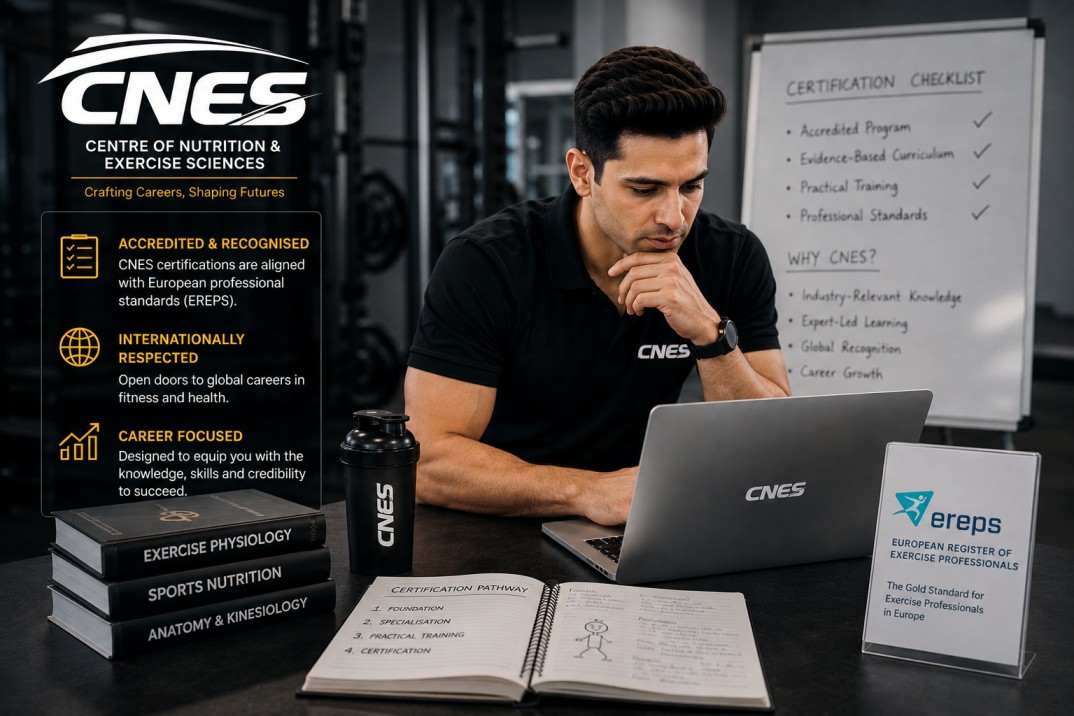
EREPS certification for personal trainers is often discussed as though it means one single thing. In reality, several different concepts can be involved: the European Register of Exercise Professionals (EREPS) itself, a training provider accredited to deliver a particular qualification, the qualification a student completes and an individual's separate professional registration with EREPS.
Understanding those distinctions is essential before paying for a course. An EREPS-accredited provider is not the same thing as an automatically EREPS-registered student, and completing a qualification does not by itself mean that a person has unrestricted work rights in every country or guaranteed employment.
At its core, EREPS is the European Register of Exercise Professionals, launched in 2007 as an independent register of instructors, trainers and teachers working in the European fitness and physical activity sector. It also provides routes to find accredited training courses and to apply for individual professional registration.
This guide explains what those terms mean, how to verify claims and how an EREPS-related pathway may fit into a broader personal training career decision.
What Is EREPS?
EREPS stands for the European Register of Exercise Professionals. It is an independent professional register focused on exercise and fitness professionals.
EREPS also publishes information about accredited training providers and qualifications delivered within the relevant standards framework.
For an aspiring personal trainer, EREPS can therefore appear in three connected but different parts of the journey:
1. Accredited Training Provider
When researching whether a particular training provider is listed as accredited.
2. Qualification
When understanding the qualification or qualification descriptor a provider is accredited to deliver.
3. Individual Registration
When considering separate professional registration as an exercise professional.
Do not treat the words “EREPS certified” as a complete explanation. Ask exactly who or what is being described.
Why Do Professional Standards Matter in Fitness Education?
Personal training involves making decisions that affect real people.
Trainers may consult with clients, gather relevant information, conduct or use fitness assessments, plan exercise, coach movement, monitor progress and adapt programmes.
The quality of education therefore matters beyond the appearance of a certificate.
Professional standards can provide a framework for defining what knowledge and competence a role is expected to involve. They can also make it easier to compare programmes against published expectations.
However, a standards-based framework does not remove the need to investigate the actual course.
Students should still examine:
- Curriculum
- Practical learning
- Assessment methods
- Faculty
- Eligibility
- Provider status
- The exact qualification being delivered
What Does EREPS Recognition or Accreditation Mean?
The safest approach is to read EREPS terminology precisely.
EREPS maintains an accredited training directory that identifies providers and the qualification descriptors they are accredited to deliver.
A provider listing therefore supports a specific claim about that provider's current accreditation status and the listed qualification categories.
A provider's accreditation does not by itself prove that every course the provider sells is accredited.
Nor does it mean every graduate is automatically registered with EREPS.
When evaluating an EREPS accredited personal trainer course, verify the exact provider name, the exact qualification listed, the current status and any expiry information shown on the official provider profile.
EREPS-Accredited Provider vs Certified Student vs Registered Professional
| Term | What It Means | What It Does Not Automatically Mean |
|---|---|---|
| EREPS | The European Register of Exercise Professionals and related professional framework. | That every fitness certificate using the name belongs to the same category. |
| Accredited Training Provider | An organisation listed by EREPS as accredited to deliver specified qualification descriptors. | That every programme offered by the organisation has identical accreditation. |
| Accredited Qualification Pathway | The particular qualification descriptor a provider is listed as accredited to deliver. | That a graduate is automatically registered with EREPS. |
| Certified Student or Graduate | A person who has completed the provider's course and met its requirements. | Automatic employment, universal work rights or automatic EREPS registration. |
| EREPS-Registered Professional | An individual whose application for registration has been accepted under EREPS requirements. | That the registration itself guarantees a job or overrides local employment or legal requirements. |
| Professional Registration | An individual status maintained under the rules of a professional register. | The same thing as provider accreditation. |
What Should a Personal Trainer Course Teach?
Course structures vary, and not every personal trainer programme covers every topic to the same depth or uses the same assessment model.
However, students comparing a recognised personal trainer certification should examine whether the programme appropriately addresses core areas relevant to professional personal training.
Client Consultation
Understanding goals, training history and relevant information needed to begin a professional relationship and plan within an appropriate scope.
Fitness Assessment
Learning the purpose and use of suitable assessment methods to understand a starting point and review progress.
Exercise Science
Building relevant foundations in anatomy, physiology, biomechanics and exercise principles.
Programme Design
Planning training around goals, current ability, training variables, progression and individual differences.
Personal Training Delivery
Communicating, demonstrating exercises, observing performance and structuring sessions.
Nutrition & Weight-Management Boundaries
Understanding the limits of a personal trainer's role and when another suitably qualified professional may be needed.
Behaviour Change
Recognising the role of goals, adherence, habits, motivation and realistic planning.
Programme Review & Adaptation
Monitoring outcomes and considering when training may need to be adjusted.
The key is not to assume coverage. Request the actual syllabus and assessment information before enrolling.
Potential Benefits of Choosing a Standards-Based Professional Pathway
A Clearer Comparison Framework
Published qualification descriptors can help students understand what type of role or competence pathway they are evaluating.
Independently Verifiable Provider Information
A current official directory can allow prospective students to check a provider rather than relying only on advertising.
Greater Transparency
Students can ask whether a specific provider is accredited to deliver a specific qualification.
A Possible Route Toward Professional Registration
Eligible individuals can separately explore EREPS registration requirements where relevant to their goals.
Continuing Professional Development Awareness
Professional registration frameworks may encourage ongoing learning rather than treating one certificate as the end of professional development.
These are potential benefits, not guarantees. Accreditation or registration should not be presented as an automatic promise of employment, income or unrestricted international work.
What Should Students Verify Before Enrolling?
Use this checklist before paying a deposit or enrolling in an EREPS-related personal trainer programme.
-
1. Exact provider name
Match the legal or listed provider name with the official EREPS directory. -
2. Exact qualification
Check which qualification descriptor the provider is actually accredited to deliver. -
3. Current accreditation status
Do not rely on an old screenshot, logo or undated marketing statement. -
4. Expiry or validity date where applicable
Check the official provider profile for current status and any displayed expiry date. -
5. Course delivery format
Understand whether learning is online, offline or hybrid and where practical components occur. -
6. Assessment
Ask how theory and applied competence are evaluated. -
7. Practical learning
Find out how practical coaching skills are taught, practised and assessed. -
8. Eligibility
Check age, education and prerequisite requirements for the exact course. -
9. Additional registration requirements
Ask whether course completion is separate from professional registration and what further application steps may apply. -
10. Renewal or CPD obligations if applicable
If considering individual registration, review current renewal, membership and continuing-development requirements directly with EREPS.
How to Verify Claims Made by a Fitness Education Provider
This is one of the most important steps in choosing a personal trainer course.
A logo, badge or phrase such as “internationally recognised” is not enough by itself. Verification should follow a documented process.
Identify the Exact Claim
Write down the claim exactly.
Is the provider saying it is EREPS accredited? Is it saying a specific Personal Trainer qualification is accredited? Or is it saying graduates can apply for individual professional registration?
These are different claims and should be checked separately.
Search the Official Directory
Use the official EREPS accredited training directory.
Search by provider name, country and qualification where available. Do not depend only on the provider's own website.
Open the Provider Profile
Check the provider name, location, qualification descriptors and any current expiry information shown on the official profile.
Compare these details with the exact course you are considering.
Ask the Provider to Explain the Pathway
A transparent provider should be able to explain what students receive after completion and whether any further step is required for individual EREPS registration.
Ask for the distinction in writing if the marketing language is unclear.
Check Individual Registration Separately
EREPS explains that individual applicants submit relevant qualifications and supporting information, after which applications are checked for compliance and equivalency against the applicable standards.
Current registration information also describes annual registration and lifelong-learning requirements.
Do not assume that graduating from a provider replaces the separate registration process unless the official current rules explicitly say so.
Check the Date
Accreditation directories can change.
A provider may have been accredited at one point but have a different current status later. Verify immediately before enrolment rather than relying on an old article or social-media post.
Common Myths vs Facts
| Myth | Fact |
|---|---|
| “If a provider is EREPS accredited, every student is automatically EREPS registered.” | Provider accreditation and individual professional registration are separate concepts. Check the current registration requirements. |
| “EREPS accreditation guarantees a job.” | No accreditation should be treated as an employment guarantee. Hiring depends on employers, roles, experience, qualifications and other factors. |
| “EREPS means I can automatically work anywhere in the world.” | Do not assume this. Employment, visa, licensing and local requirements can vary. |
| “All EREPS-related courses have the same curriculum.” | Providers and programmes should be checked individually. Review the exact qualification and syllabus. |
| “A logo on a provider website proves current accreditation.” | Use the current official EREPS directory and provider profile to verify the claim. |
| “EREPS and every organisation using the word REPS are the same.” | No. Do not confuse EREPS with REPS India or other national or professional registers. Check the exact organisation and framework. |
| “Every fitness certification has the same recognition.” | Recognition depends on the provider, qualification, standards framework, employer expectations and context. |
EREPS and the Indian Fitness Education Landscape
For Indian students, the practical question is not whether an international framework is automatically better than every other pathway.
The useful question is whether a particular provider and qualification can be independently verified and whether its learning structure fits the student's goals.
The current EREPS accredited training directory includes multiple providers located in India under relevant qualification categories, including Personal Trainer.
This demonstrates that Indian students can find providers listed in the EREPS directory, but each provider and qualification must still be checked individually.
Students should not confuse an EREPS listing with:
- Automatic individual registration
- A government licence
- A guarantee of employment
It is one piece of information in a broader education decision that should also consider curriculum, practical competence, assessment, faculty, costs and career goals.
How to Choose Between Different Personal Trainer Certification Pathways
An EREPS-related pathway should be evaluated alongside other credible options rather than through a simplistic “EREPS versus everyone else” comparison.
Questions to Compare Different Pathways
- What will I actually learn?
- How is practical competence developed?
- How are students assessed?
- Who teaches the course?
- What recognition or standards can I independently verify?
- Does the exact pathway suit my eligibility and career direction?
- What is the full cost?
- What does the certificate represent after completion?
- Is individual professional registration separate?
- What continuing education may be useful later?
For a wider buyer's framework, read “Best Personal Trainer Course in India: How to Choose the Right Certification.”
Readers at an earlier stage of their career journey can also read “How to Become a Certified Personal Trainer in India: Step-by-Step Career Guide for 2026.”
Where Does CNES Fit Into This Pathway?
After understanding the terminology, students can evaluate CNES using the same evidence-based approach applied to every provider.
At the time this article was researched, the official EREPS accredited training provider directory listed CFNES Fitness Academy LLP in India as accredited to deliver the Personal Trainer qualification descriptor.
The provider profile identified CFNES Fitness Academy LLP, listed India as its location, showed accreditation for Personal Trainer and displayed an expiry date of 30 April 2028.
This information should be independently re-checked against the live EREPS directory before publication or enrolment because provider status and accreditation information can change.
This should be described accurately: the official listing supports the claim that the named provider is currently listed as accredited to deliver the Personal Trainer qualification descriptor.
It should not be exaggerated into a guarantee that every graduate is automatically EREPS registered, employed or entitled to work without meeting other applicable requirements.
Prospective students should independently check the live EREPS directory and the exact CNES Certified Personal Trainer course details before enrolling.
They should also compare curriculum, eligibility, delivery format, practical learning and assessment with their own career goals.
How to Use This Information Before Choosing a Course
A trustworthy certification decision usually follows a simple sequence:
- Understand the terminology.
- Identify the exact claim.
- Verify it independently.
- Review the course itself.
- Decide whether the pathway matches your goals.
Do not buy because a certificate sounds international.
Do not reject a pathway simply because you do not recognise an acronym. Investigate the evidence.
For students comparing multiple courses, the next useful resource is “Best Personal Trainer Course in India: How to Choose the Right Certification.”
For those deciding whether personal training is the right career, read “How to Become a Certified Personal Trainer in India: Step-by-Step Career Guide for 2026.”
If CNES is one of the providers you are evaluating, review the current Certified Personal Trainer course information alongside the official EREPS directory.
Frequently Asked Questions
The phrase can refer loosely to an EREPS-related education or professional pathway, but it is important to distinguish provider accreditation, a qualification and individual registration.
EREPS is the European Register of Exercise Professionals.
Do not assume so. EREPS is the European Register of Exercise Professionals. Other organisations may use REPS in their names, including national registers.
Always identify the exact organisation and framework.
No. Accreditation should not be presented as a job guarantee.
Employment depends on many factors including employer requirements, qualifications, skills, experience and the role.
Search the official EREPS accredited training directory, confirm the exact provider name, open its current profile and check the qualification descriptors and displayed status or expiry information.
No. Recognition can differ according to the provider, qualification, professional framework, employer expectations and country or context.
Verify the provider, exact qualification, current accreditation, delivery format, practical learning, assessments, eligibility, full costs and whether additional professional registration or renewal requirements apply.
No. A provider may be accredited to deliver a listed qualification, while an individual professional registration involves a separate application and compliance process.
Do not assume this.
Work rights and employment requirements can depend on immigration, local laws, employers and other requirements outside the scope of provider accreditation.
Thinking About an EREPS-Related Personal Trainer Course?
Understanding EREPS certification starts with knowing the difference between an accredited training provider, an accredited qualification and individual professional registration.
Before enrolling, verify the provider and qualification through the relevant official sources, review the course curriculum and practical learning structure, and understand what the completed qualification actually represents.
If you are considering CNES, explore the current CNES Certified Personal Trainer course alongside the official EREPS information and evaluate whether the pathway matches your career goals.
Accuracy Note: EREPS information, provider status and registration requirements can change. Before making an enrolment or career decision, verify the current provider profile, qualification information and individual registration requirements directly through the relevant official sources.
Related Articles
Certified Fitness Trainer Course in India: Eligibility, Skills, Career Scope & How to Choose the Right Course
Learn about certified fitness trainer courses in India, including eligibility, curriculum, practical skills, career scope and how to choose the right programme.
Personal Trainer Course Fees in India: Complete 2026 Cost & Comparison Guide
Compare personal trainer course fees in India, what different programmes include, why prices vary and the costs to consider before choosing a certification.
Why a Gym Franchise Alone Isn't Enough: How Fitness Education Can Build a Stronger Gym Business in India
Explore how fitness education, professional certifications and trainer development can complement a gym business and create additional opportunities beyond memberships.